Budapest Airport Terminals
All the information featured on this page was compiled and written by David Enrich, a renowned expert in aviation and airport guides since 1999.
Budapest Ferenc Liszt International Airport (IATA: BUD), located about 16 km southeast of central Budapest, is Hungary’s largest airport and the country’s principal international gateway. It has grown from a modest airfield into a regional hub serving over a hundred destinations and a mix of legacy and low-cost carriers.
If you’re staying in central Budapest, allow 35–60 minutes by car depending on traffic; the airport is well connected by shuttle buses and taxi services.
Brief historical background & origins
The idea to build a new airport for Budapest dates back to the late 1930s; after World War II the site at Ferihegy (now called Ferenc Liszt Airport) was developed for civil aviation. Major modernisation phases followed — notably the construction and opening of Terminal 2 in the 1980s and later the expansion work that created the SkyCourt and Pier B (a multi-gate pier connected to Terminal 2). The airport passed through public-private ownership and significant modern upgrades in the 2000s–2010s.
For aviation/history buffs, parts of older Terminal 1 were preserved and have historic architectural interest — though it is not used for regular scheduled traffic today.
Terminal layout — description, zones & levels
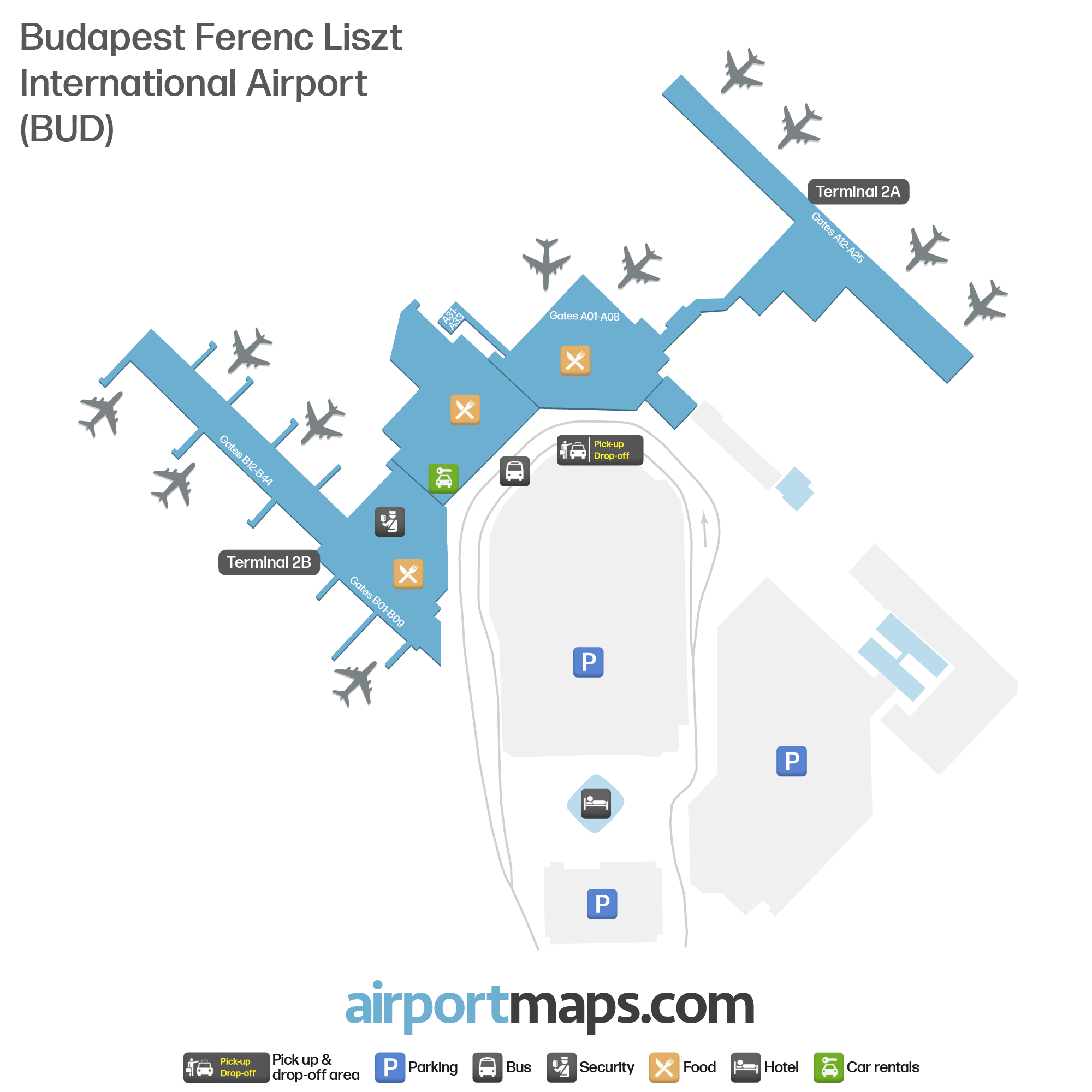
Today the passenger facilities are organised around Terminal 2 (split operationally into 2A and 2B) and the SkyCourt that links them. Key elements:
- Terminal 2A (Schengen departures/arrivals) — handles flights to/from Schengen countries; has check-in halls, departure concourses and landside facilities.
- Terminal 2B (non-Schengen/international) — serves non-Schengen and intercontinental flights; connected to Pier B (opened 2018) which added many gates and jetbridges.
- SkyCourt — central circulation, shopping and waiting area between 2A and 2B; contains many shops, F&B outlets and passenger amenities.
- Levels / typical flow: Arrivals (ground/arrival level) → check-in / departures (ground/first floors depending on terminal) → security → airside / gates (upper concourses or piers). Pier B provides many jetbridges for wide-body and medium-haul operations.
If you have a Schengen-to-non-Schengen connection, expect to pass through passport control between 2A and 2B — allow extra time for that transfer.
Popular routes (summary table)
Below is a compact table of some of Budapest’s busiest / most popular routes, typical non-stop flight durations, and main operators. Flight times are approximate (typical non-stop scheduled times) — always check your airline for the exact timetable.
| From BUD (destination) | Typical flight time (approx.) | Main airlines operating the route |
|---|---|---|
| Istanbul (IST) | ~2 hr 15 min | Turkish Airlines, Wizz Air. |
| London – Stansted / London (UK) | ~2 hr 35–2 hr 45 min | Ryanair; also BA/other airlines to Heathrow/other London airports. |
| Frankfurt (FRA) | ~1 hr 45 min | Lufthansa (plus other operators/codeshares). |
| Barcelona (BCN) | ~2 hr 10–2 hr 30 min | Ryanair, Wizz Air, Smartwings (seasonal mixes). |
| Tel Aviv (TLV) | ~3 hr 10–3 hr 35 min | Wizz Air, El Al and seasonal/operators. |
Low-cost carriers may operate to secondary London airports (Stansted, Luton) — if you want Heathrow or Gatwick specifically, pick the flight carefully.
Interspersed practical tips
- Transfer time: For international connections between Schengen and non-Schengen, plan 90–120 minutes if changing terminals or airlines.
- Peak times: Business peaks are weekdays early morning and late afternoon; leisure peaks in summer weekends.